I was caught up in this story from the first page. I found so much exciting magic in this book, it left me breathless! The story was gripping and intriguing. I could not put this book down. I had a difficult time not sneaking my iPad in to the classroom with me. All of the characters were vivid and full of history. I was excited to learn more about the world of witches. There were also some new characters introduced that I have strong opinions about, but I'm not sure what those opinions are yet. I cannot wait for the next installment in this great series!
Wednesday, October 9, 2013
Broken Spell
Broken Spell by Fabio Bueno was amazing! I really enjoyed Wicked Sense, the first in the series about a young witch sent to Seattle to find The Singularity, the most powerful witch ever to exist. Skye, the young witch charged with this task is unique in her ability to sense witches, even from a great distance. In this sequel, Skye has found The Singularity, but has chosen to hide her identity. It is up to her and her boyfriend, Drake to keep The Singularity a secret until she can get a hold on her unprecedented powers. With danger and tragedy facing their small group of friends, Skye and Drake will have to decide if they are going to work together or apart.

Thursday, October 3, 2013
Wicked Sense
Skye is a witch with the unique talent of being able to sense when other witches are around. It is up to her to go to Seattle to find the most powerful witch that has ever lived. She wants to remain inconspicuous, but her incomparable beauty makes her irresistible to Drake. Their new found friendship leads them to trouble as they both search for the Singularity in The high school.
I really liked this story. The characters were well-developed. The story was full of suspense. I love a world that contains witches. I only wish there had been a little more magic thrown in. Or some explanations of spells. But this is just a personal preference because I love to read about magic.
I would love to read more about Mona and her life, but I am hoping that will be in the next book. I am really excited to see what happens next in the lives of these characters. This book is so well written that it could be read as a stand alone, but I am very glad that there wil be more!
Wednesday, June 12, 2013
Where'd You Go, Bernadette?

I laughed out loud. That is the mark of a great book. Not often do I laugh out loud. I might chuckle, or grin, usually I just inwardly "humph." But when I laugh, whole-heartedly, out loud, I know I have been entertained. Where'd You Go, Bernadette? is the story of young, Bee and her eccentric mother Bernadette. Bee is impossibly intelligent with eclectic tastes and very little self-editing abilities. But where Bee is outgoing and impish, her mother is somewhat of a hermit. Keeping to herself in their large, run-down home, she uses an assistant whom she met on the Internet to do all of her shopping, or anything that requires interaction with people outside of her home. Bree's father, a genius at Microsoft, has all but forgotten about his family when his wife goes missing. This story is sad, hilarious, and poignant. I didn't want the story to end. But when it did, I was not disappointed. There is a little bit of language in the book.
Divergent

Dystopian YA fiction is a genre I had sort of gotten bored with. I have read the Hunger Games Trilogy. I have read the Matched Series. I've read some Zombie apocalypse novels and I thought I was done. I had grown a little bored with this type of story. But I kept hearing about Divergent by Veronica Roth and decided to take a chance. I'm glad I did. I have heard many comparisons to the Hunger Games, but, to be honest, the only similarities I found were that they are both about a girl, and they are both dystopian. Divergent is about a strong, young woman who must choose between staying with her family in the home in which she grew up, with the standards she has come to respect, or choose another path. Choose the community that she has always admired and has felt a kinship with. There is a bit of a love interest, no YA novel would be complete without one. Tris, the main character, has conflict, turmoil, teenage angst. And while all of this is not incredibly original, it is very entertaining. Don't let other reviews turn you off, if you are kind of tired of Dystopian fiction. This is a great story, with great characters. There are sequels to the book, that I may or may not read, but I believe this book does well to stand on it's own.
Friday, November 2, 2012
Proof of Heaven

Colm is a little boy who is dying.
He knows it. His mother knows it. His doctor knows it. Coming to terms with
this knowledge, Colm tries to placate his mother by pretending to believe in
the healing powers of faith that she believes in. But he grows tired, physically
and mentally. It is time for Colm to tell his mother the truth: There is no God
and there is no life after death.
In Mary Curran-Hackett’s “Proof of
Heaven,” a little boy is trying to deal with a very grown-up problem of facing
his own mortality. He knows he is going to die but he has one mission on this
earth that he would like to fulfill before his life ends and that is to meet
his father. He knows it will hurt his mother if he tells her this, so he does
his best to do this on his own.
With the help of his Uncle Sean and
his doctor, he is confident that he will be able to find his father and gently
break the news to his mother of his impending death. While Colm’s mother,
Cathleen will stop at nothing to save her son. Her faith in God is unwaivering,
as is her faith in their doctor and new friend, Dr. Basu. She knows that there
is a way to heal her young son and restore his health so that he can grow up
with her.
This book asks questions about
love, death, and the afterlife. It is an exploration of the unbreakable bond of
mother and child. It is about what makes a family. Most of all, this book is a
journey about faith. It is about the different phases of faith in people’s
lives. There are many ways to exhibit faith, whether it be through the ritual
of religion, whether it be through science, or whether it is simply through the
faith we have in our friends and family. This book is a reconnaissance of faith
in all of it’s facets.
This is Curran-Hackett’s debut
novel. She uses experiences from her own life to paint a very real picture of a
boy and his mother who seem to be out of hope, but are never out of faith.
Saturday, October 6, 2012
The Violets of March
Emily Wilson has a seemingly perfect life. She has a perfect
husband, a great career as a writer, and she lives is a beautiful apartment in
Manhattan. Then her husband throws her a curve ball and all at once her
marriage is over
To escape her own melancholy, she goes to visit her Aunt Bee
on the West Coast. There she finds peace, a little romance, and something she
never bargained for: a mystery.
Emily finds a journal at her aunt’s old house that contains
a story of love and betrayal, but she cannot figure out if the story is real or
fiction. The more she reads, the more involved she becomes and the more
determined she is to find out who wrote this story. She has to figure out who
the main players are in this story before she can get to the bottom of what
really happened.
When Emily comes to terms with who the people are in the
story and the end result of everything that happened, she is able to sort her
own life out and free herself enough to find love and invite it into her own
life.
“The Violets of March” by Sarah Jio is very much a romance.
But because there is a great mystery involved, I did not mind the romance too
much. It wasn’t mushy or boring as most romances tend to be.
While The book did not totally keep me enthralled, it was a
fun, quick read that let me escape a little into that West Coast, beach front,
life. I did not necessarily
identify with the main character, as my life is as far from hers as possible,
but I could sympathize with her plight.
I was also very intrigued by the mystery surrounding the
journal that she found. This was definitely the best part of the book. I wanted
to know who the people were. Were they people that Emily knew? And where are
they now? This dual storyline kept me reading with anticipation.
Tuesday, August 14, 2012
The Language Of Flowers Column 24
In Victorian times, before there was texting and
Facebooking, there was floriography. This “language of flowers” used various
flowers and floral arrangements to send coded messages to others. It allowed
individuals to express feelings that they might not want to speak aloud.

“The Language of Flowers,” by Vanessa Diffenbaugh introduces
a young woman aptly named Victoria who has an affinity for flowers and their
meanings. She can communicate through flowers what she cannot communicate
through words or any other way.
Victoria grew up in the foster care system. When she turns
eighteen, it is time for her to find a job and take care of herself. She
becomes homeless and plants and cultivates a garden of her own in a public
park. When a florist discovers her talents, Victoria also realizes that she has
a gift for choosing the right flowers for the right occasions for the right
people.
Victoria is not a likable character. She is mean. She makes
very bad choices. She has been hurt so much in her life that she hesitates to
let anyone into her life. But I found myself drawn to her. I sympathized with
her. I wanted to go back in time and take care of her as a 9 year old and tell
her that everything was going to be okay.
This book takes place in the present as well as Victoria’s
past. We find out why Victoria became the way she is.
I cried while reading this book. I sobbed while reading this
book. I know some people might find it a bit sentimental, but I could not stop
reading it. I read the book in one sitting.
Some people I have talked to feel like the character is so
unlikable that they could not relate to her at all. I guess I have always had a
soft spot for children in the foster care system. I was glad Victoria was a
fictional character, but I worry so much that there are many children in our
system that are just like her. It breaks my heart that they children can slip
through the cracks.
The story was not the only thing that I loved about the
book. There was so much information about this Victorian Language of Flowers
that I had to know more! I find it fascinating all of the meanings of the
various flowers. And flowers that so many of us associate with certain
feelings, mean the opposite! For example, I have always thought of sunflowers
as being happy and bright and cheerful, but the Victorian meaning is
“haughtiness.”
At the end of the book, Diffenbaugh encloses Victoria’s dictionary
of flowers and their meanings. It is definitely a reference that I will use in
the future. This book made me want to send flowers to a friend. Of course, I
haven’t done that, yet. I always figured, why send flowers when you can send
chocolate? Is there a Language of Chocolate out there? That is something I need
to get fluent in.
Monday, July 30, 2012
The Night Circus by Erin Morgenstern

I
remember going to the circus several times as a kid. Surprisingly, the most
memorable was also probably the most uneventful.
We lived in Philadelphia at the
time. I must have been about 11 or 12 years old and I was really excited. We
had been to the circus before and I knew what was coming! I was anticipating
the elephants, the acrobats, the clowns and the cotton candy.
We left on a cloudy afternoon to
search for this circus somewhere outside the city limits. I am pretty sure my
mom had no idea where we were going. And it started to rain. Then it started to
pour. After what seemed like forever, we finally arrived at the circus and I
remember having to tromp through a huge mess of mud to get to the arena. But
when we got to the gates, the circus was closed. It had been shut down due to
the rain.
I remember being totally
devastated. I was angry with my mom for dragging us all the way out in the
middle of nowhere for nothing. I had looked forward to all of the magic the
circus had to offer only to have my hopes crushed.
“The
Night Circus” by Erin Morgenstern invoked all of those feelings of wonder and
anticipation that I had about the circus. The descriptions of the sights, the
sounds, and the smells that you can only experience in a carnival atmosphere
really made me feel like I was right there.
The
book does not tell the story of any ordinary circus, however. This is Le Cirque
des Reves, a magical circus that arrives without warning. Within its tents, the
stage is set for a fierce competition—an impossible battle of skill and
imagination between Celia and Marco, who have been trained in magic since they
were young. Now is the time for them to show what they have learned. However,
this encounter can end with only one of them standing.
This
book is part fantasy, part romance, and part intrigue. There is no one category
that could define this book. It was fun, and I wanted to find out what happened
in the end. The cast of colorful characters was fun to get to know, and it was
devastating to lose some of them.
Morgenstern’s
descriptive prose was so intense that I could picture in my mind exactly the
way everything looked and felt. I still have those pictures in my head. “The
Night Circus” left me wanting to go to that magical place. I want to find that
circus, or any circus or carnival for that matter, so I can experience
everything that goes with it.
Unfortunately,
circuses are few and far between. Their live performances have been replaced by
screens. We are so inundated, as a society, with computer-generated imagery,
that illusions and circus magic no longer impress younger audiences.
But nothing can replace a good
book. Your imagination is always more brilliant than anything that can be
produced on a screen.
Friday, July 6, 2012
Column 22

Madeleine L’Engle is an author you may know from your
childhood. She wrote “A Wrinkle In Time,” “A Ring of Endless Light,” “Troubling
A Star,” and numerous other books for youth.
Madeleine
L’Engle was also of woman of great faith. She believed in the sanctity of
marriage and of family. She lived a fascinating life. You can read about her
life through her memoirs, a four-book series entitled “The Crosswicks
Journals.”
My
favorite in this series is without a doubt “Two-Part Invention.” In this
memoir, L’Engle explores her relationship with her husband. She begins by
talking about her childhood and then her young adulthood. She quickly moves to
meeting her husband, actor Hugh Franklin, and their courtship.
Theirs
was a chaste and atypical courtship in that they did not rush things or make
flippant moral decisions as did others who ran in their circle. They were
“theater people,” which meant that most of the people around them did not blink
an eye about “sleeping around” and moving from one partner to the next without
qualm. Both of them decided to stay chaste until marriage, despite the
pressures around them to the contrary.
When
they were married, they were hopelessly devoted to one another. Never giving up
his dream of acting, Hugh continued to work on Broadway and eventually in
television, where he landed a long-time acting position as Dr. Charles Tyler on
the soap opera “All My Children.” This was his most well-known role.
L’Engle
supported her husband in his often difficult career. She never asked him to
sacrifice his dream. She became a mother and homemaker while keeping her career
as well. She wrote many successful books and had an acting career too.
In
this book we see the ups and downs of their marriage through humor and stories
that only L’Engle could make funny and interesting. When Hugh gets cancer, we
see her undying devotion and the love and passion she has for her husband, even
after many years.
This
has to be one of my favorite books of all time. I have read it three times.
Each time I get something new out of it. Each time I read it I gain a personal
strength that makes me know that, although marriage is tough, it is worth all
of the pain. Your spouse is your best friend. Your spouse is the person with
whom you want to share everything.
Through her intimate thoughts and
memories, L’Engle shows the reader that a perfect marriage is possible. A
perfect marriage is your own marriage if you work to make it that way. As
L’Engle puts it: “Love
of music, of sunsets and sea; a liking for the same kind of people; political
opinions that are not radically divergent; a similar stance as we look at the
stars and think of the marvelous strangeness of the universe—these are what
build a marriage. And it is never to be taken for granted.”
L’Engle and her husband are no
longer living, but their amazing example lives on in her immortal pages. I know
that even though this was my third reading of “Two-Part Invention” it will not
be my last.
Wednesday, June 20, 2012

In
a time where women are not considered citizens according to the law, Lyddie
Berry is a widow who struggles to maintain a modicum of autonomy after her
husband dies in a whaling accident. This is how “The Widow’s War” by Sally
Gunning begins.
According
to the law in 1761, Widow Berry is entitled to one-third of her husband’s
property. This means she may use one-third of her house. She also has use of
the cow, the chickens, and part of the land to plant a garden.
Lyddie
is expected by her son-in-law to turn all of her property over to him so that
he can sell it off for a profit. She is expected to move in with his family and
live the remainder of her days in his debt. This is what society dictates, and
it is what her friends and daughter expect her to do.
Lyddie
has other plans, however. She has lived many lonely years as a fisherman’s
wife, taking care of her home and her property on her own while her husband was
out to sea. She doesn’t see why things have to change.
So
through the help of a dear old friend who happens to be a lawyer, Lyddie tries
to change how things have always been. She determines to make full use of that
one-third of the property that is rightfully hers.
She
makes friends with an Indian man who hires her to keep his house so that she
has a little bit of money to buy necessities. But he is the only friend she
makes in this endeavor. She has lost her friends. Her community has shunned
her. Her own daughter has even turned her back on Lyddie. She has only her own
will to go on.
But
her son-in-law does not make things easy. He does everything in his power to
make her life more difficult. He wants the money that the sale of the house
would bring and will stop at nothing to get it.
This
is an inspiring fictional story about a woman who is determined to take her freedom
from those who refuse to give it.
I
was rooting for Widow Berry from the very beginning. She is a heroine who tries
to do what society expects of her, but in the end, has to follow her heart. She
challenges the political, the religious, and the societal views around her in
order to be happy.
June 19 marks the anniversary of
the day in 1873 that Susan B. Anthony was
fined $100 for the federal crime of voting (in the 1872 presidential
election) without the right to vote. She is a great woman that stood up for
women’s rights in the history of this great country. “The Widow’s War,”
although fictional, helped me appreciate the many heroines who have made my
life, as a woman, a little easier.
Tuesday, June 12, 2012

To be honest, I was a little under-whelmed. It did not grab me much at all. I really had a hard time relating to the characters in the first half of the book. And when the author described the "Pretties," I just could not wrap my head around how they could be at all attractive.
But I kept reading. I thought there had to be something to all of the hype that everyone was creating around this series. After about 150 pages, I kinda got it. Once Tally, the lead character who is an, "Ugly," leaves her comfortable home, I really started to identify with her and I started to root for her.
I also really liked the description of "the ruins." This is supposed to be our current world about 300 years into the future. It fascinates me to think about what people will think of us in the future. I think Westerfeld really made this come alive for me. I get a kick out of picturing our dystopian future.
I like even more when he starts to describe how it all happened. I want to know more about how our civilization came to destroy itself. I watched "Rise of the Planet of the Apes" last night and I got the same thrill. The thrill of knowing how an entire civilization can come to ruin.
Basically that is what this book is about. It is about how we, the human race, are so centered on what people look like that we took ourselves out. We ended up creating a world where everyone looks the same and thinks the same and acts the same. This is to take out any chance of ruining ourselves ever again.
So, while I was a little disenchanted at first by this book, by the middle, I was hooked. And now I can't wait to read the next one. I really hope it goes more in depth about the fall of our civilization. I look forward to seeing what the next book in the series has to offer. I am not committed to the characters quite yet, but I do look forward to seeing what they will be up to in the next installment, "Pretties."
Thursday, June 7, 2012
Column 20 How to be an American Housewife

“How
to Be an American Housewife,” by Margaret Dilloway, is a glimpse into the life
of Shoko, a Japanese woman who marries an American soldier after World War II
in an attempt to escape her bleak prospects: a life of manual labor and
near-starvation patterned after the fate of her mother and the Japanese women
before her.
The
book begins at the end of Shoko’s life and flashes back to the past, beginning
with her dream of being a housewife to an American GI. She knows it will be a
challenge to raise children in America and still incorporate traditional
Japanese customs, but Shoko is an intelligent woman who feels that if anyone
can make good on this dream she can. So she finds an American soldier to marry
and brings two children into the world in the United States.
The
title of the book refers to a fictitious book that Shoko’s husband, Charlie,
gives her to help her assimilate into American culture. There are snippets from
this “book” at the beginning of each chapter. Dilloway explains in the author’s
note that her own mother received a similar book that was a guide for Japanese
brides marrying American men.
I found myself very interested in
the customs of the Japanese while reading this book. I was interested in their
religions and the way they eat. I thought it was interesting how they revere
their male children more than their female children. They let their sons get
away with everything and ask them to do nothing, while the girls are stuck with
all of the work and are expected to be perfect.
Somehow, the boys who are raised this way still have some
kind of a work ethic. The daughters grow up pleasing their parents and becoming
submissive wives.
But Shoko does not experience this
with her children. She tries raising her son and daughter in this traditional
Japanese manner in America and finds that she ends up with a lazy, full-grown
man who lives with his parents well into his forties. Her daughter becomes a
bitter, disenchanted single mother who wants nothing to do with the Japanese
way of life.
Before she dies, Shoko wants to
reconcile with her brother, who disowned her years before when she married an
American. With her failing health, it is impossible for Shoko to travel to
Japan for a reunion, so she sends her daughter, Sue, in her place. This trip reveals
family secrets that change the way Sue views her mother and the world around
her.
Told from the points of view of
Shoko and her daughter, “How to Be an American Housewife” offers an intimate
glimpse into the lives of this Japanese-American family. It is engaging and
entertaining, and I did not want to put it down.
In particular, the story made me
want to know more about the women who came over from Japan seeking a better
life in America. Were they happy with their choice to come here? Is America
what they expected? Would they have chosen to go back to Japan if they could?
I am also curious to know how much
Japan has changed since that post-World-War-II era. Are there women in Japan
who still want to leave their country to come to America to seek “a better
life?” I would definitely like to read more about this subject and seek out
other books by this author.
Friday, June 1, 2012
column 19
One
day you are volunteering at your child’s school as the cafeteria mom. It is the
end of lunch and almost all of the children are outside on the playground
except for three little girls who have been teasing your daughter and your
daughter who has run into the bathroom. There is a sudden explosion from the
kitchen. When you come to, you find the three children crying, covered in soot
and ash. You know that you have to get the children out of the building, but
your daughter is still in the bathroom across the cafeteria. What do you do?
This
is the beginning of the book “Save Me” by Lisa Scottoline. The decision this
mother makes and how she executes her decision affect her life dramatically
over the next few months and beyond.
I
know, it sounds intense. It is really intense, but so good! But the book
doesn’t stop there. There is also a mystery involved, as there is with all of
Scottoline’s books. We find out what caused the fire and why all of this
affects the main character, Rose, so deeply.
This
book is an accurate portrait of just how far a mother will go to save the ones
she loves. It is emotional, heartbreaking, and a thrill to read. Let me be
honest, it is not some great intellectual piece of literature. But it was a
quick, fun read.
I
have read all of Scottoline’s books. Most of them are law mysteries. They are
about a lawyer who lives in Philadelphia who is constantly getting into trouble
by being in the wrong place at the wrong time. I love these books. They are
easy, fast, no-brainers. I started reading them because they all take place in
Philadelphia, where I spent my elementary and junior high years. I love to read
about the places that I am familiar with.
I
never expect more out of these books than to be entertained. They are
entertaining. They grab me from the first chapter and make me want to read
until I have finished the last page.
But
this book surprised me. It actually made me think a little. I was confronted
with the “what would I do?” scenario. And I was curious, as well, as to how I
would react if I had been the parent of one of the other children. How would I
feel if there was a disaster at the school of my child? How would I react if my
child had been seriously injured at school? Would I blame the school? There are
also the legal ramifications. Would I want to sue someone?
While
this book might not be an American classic, it is a great way to escape your
daily duties. It is a fun read—a wonderful “beach read.” (Does Rigby Lake count
as “the beach?”)
Friday, May 11, 2012
Column 18 The Thirteenth Tale
Every once in a while I read a book that I can’t put down
and I know I will want to read again. This was the case with “The Thirteenth
Tale” by Diane Setterfield.
One
of the main characters of the book is Vida Winter, a fictitious famous author
in England who has eluded biographers for fifty years, telling them only
invented stories about her life and making up her past as she goes along. When
she gets ill and learns that her life is fading, Winter turns to an amateur
biographer, Margaret Lea, to trust to tell her life story from its eccentric
beginning to its tragic end.
Margaret
is a bookish sort who has remained almost cloistered in her father’s bookshop
all of her life, choosing to lose herself in the lives of the dead—through old
books—rather than to foster relationships with the living.
After
receiving a request from Winter to
write her biography, Lea reads a rare copy of Winter’s “Thirteen Tales of
Change and Desperation.” She is intrigued by the stories and rather confused
when she finds that there are only twelve stories rather than thirteen. It is
then that she wonders, “Where is the thirteenth tale?” And her curiosity leads
her to agree to tell Vida Winter’s
“true” story.
Winters
tells her life story as would any novelist, insisting on beginning at the
beginning and going to the end, with no deviations. Margaret records Winter’s
account and begins her journey in finding out all of the family secrets of the
Angelfield family, including the skeletons in the closet that continue to haunt
them now.
This
story of Gothic suspense had me enthralled the minute I opened the first
chapter. There are so many interesting characters and stories to try to figure
out, that I did not want to stop reading. This book left me wanting more, but
it wrapped up rather nicely in the end.
The
book is full of beautiful references to, and about, books. Margaret’s love of
books is something almost sacred to her, and it made me almost weep.
Of
course, I was excited to read this book when I read that it was a ghost tale.
But if you are not into the supernatural, do not let this put you off. It is
not full of weird, implausible plot points. It is also not scary. It is a
suspenseful book that has twists and turns that you will never see coming.
It
is a book that you will definitely want to talk to someone about when you are
finished, so I suggest you read it for a book group selection or have a friend
read it as well. Or, email me! I will be happy to talk with you about it. I am
looking forward to the day when enough time has passed that I can read it
again. I know there are so many things in the book that I might have missed.
Monday, April 30, 2012
Column 17
People always want to know where to find new books to read.
There are a lot of resources that can help you choose books, including people
that share your passion for the same genre. There are even places to get free
books!
Most
of the places that I go to for book ideas are sites on the internet. My primary
resource is Goodreads.com. A social network for readers, Goodreads is a great
place for you to catalogue the books you have read, as well as keep a list of
books you would like to read. You can have “friends” on Goodreads, kind of like
Facebook, and find out what they are reading as well.
Unlike
Facebook, however, I have expanded my friends list to include people I don’t
know personally. If I find a person on Goodreads who reads and likes similar
books as me, I will become friends with them just to keep up with their reading
lists and get ideas of what to read.
Goodreads
also has giveaways where you can get free books, and many authors who are
members of Goodreads keep blogs so that you can see what their latest projects
are. Shelfarie is a similar website to Goodreads, but I have not really gotten
as involved on that site.
I
also receive several newsletters for readers by email. My favorite is Shelf
Awareness for Readers. This newsletter comes every Tuesday and every Friday. In
this newsletter there are book reviews about the latest books, as well as
suggestions for books that are older.
Shelf
Awareness also has great articles by readers and writers about books and
writing. Some authors pitch their latest projects, and there are book giveaways
on the site as well.
I
get a lot of great ideas from these newsletters. The reviews of the books are
divided by genre, which helps when I am looking for a particular book to read.
When I see a review of a book that I might be interested in, I usually go back
to Goodreads and put it on my “to-read” list.
Another
newsletter that I get about once a month is Reading Group Choices. This is a
website geared more toward book clubs, but it has some great ideas about books
to read. It is also a great resource to use if you would like to start a book
group. It tells you how to get started and how to have a successful book club. Reading
Group Choices also publishes a book each year comprised of one-page summaries
of great book club books to read. I gave all the members of one of my book
clubs a copy of this book for Christmas, and I think it will be a great place
for us to find books to read in the future.
There
are also a million blogs out there that you can follow to find some great books
to read. Iamareadernotawriter.blogspot.com is one of my favorites. Kathy, the
inspired blog author, writes about several books a week and does interviews
with authors as well as giveaways. She has a great selection of books and does
not stay with only one genre, which is something that I really like. Also, if
you are interested in writing your own book blog, she is a great resource on
how to get started. I get most of my requests for reviews from authors that she
has sent my way.
Despite
the abundance of internet resources for finding a great book to read, sometimes
a personal recommendation is still the best. Talk to people who have the same
interests you have and ask them what they are reading. You may be pleasantly
surprised with the books you will find!
Tuesday, April 24, 2012
column 16
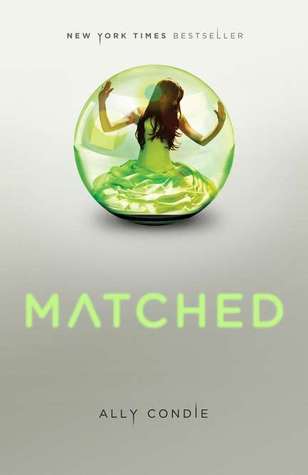
With all of the attention on “The Hunger Games,” right now,
I thought I might suggest a series that is similar without the horror of
children killing other children. The genre of dystopian young adult fiction
seems to be very popular right now. There is no shortage of books to quench
your thirst if you can’t get enough of this kind of story.
The
“Matched” series by Ally Condie is one of the thousand or so series out there
for young adults or anyone who likes to read about another society created in
the mind of a very clever author. In this world, “the warming” has come and the
“Society” is trying to prevent the end of the world by making choices for
everyone.
The
Society has chosen one hundred stories, one hundred paintings, one hundred
songs, etcetera for everyone to hear and see. The Society chooses everyone’s
professions, everyone’s mate and how many children everyone can have. They even
choose when everyone will die.
Cassia
is satisfied with her life in this world. She is happy with her ideal chosen
mate, until she sees Ky’s face flash an instant on the matching screen before
fading to black. It is then that Cassia begins to question everything she has
ever known.
Is
she really happy with her life? Are her parents, grandparents, neighbors,
friends, happy with Society making all of their decisions for them?
The
premise of this first book, “Matched,” is engaging and promising. I read it
when it was first published two years ago and awaited anxiously for the sequel
which was released in November. I just got my hands on a copy of the second
installment of this trilogy, “Crossed.” I read it in a few hours.
The
second book is different from the first in that it takes place outside of the
Society that has been created. Cassia has chosen who she wants to be with and
does her best to find him. But without the kind of “love-triangle” from the
first book, there was not quite as much tension.
What
I really like about this series is that it is very clean. I could easily allow
my twelve-year-old daughter to read it without being concerned about content.
It is not overly intense. And there is not sexual content or innuendo.
I
really liked reading “The Hunger Games.” But I have not let my daughter read it
because she gets scared easily and I think it might be a little too intense for
her. The situations are dire in those books. Life seems hopeless.
These
books are less about survival of the fittest and more about having free agency.
They are about making choices whether those choices are good or bad. And who
determines whether a choice is a good choice or a bad choice?
So,
if you liked “The Hunger Games,” take a look at the “Matched” series by Ally
Condie. I know it is always nice to find a new series to read and the final
book in the series comes out in November.
Wednesday, April 4, 2012
column 15
I never learned about Japanese-American internment camps in the United States when I was a child, so it has been shocking for me, as an adult, to read about this dark period in the recent past of the United States. It is even more shocking to read that it took place not far from my current backyard.
During World War II, people of Japanese descent who had been born and raised in the United States were put in camps, which were essentially prisons, because of their heritage and the color of their skin.
Julie Otsuka writes about this embarrassing chapter of the history of our country in two gripping and eye-opening novels, “When the Emperor Was Divine” and “Buddha in the Attic.”
In her debut novel, “When the Emperor Was Divine,” Otsuka portrays the life of a family that is taken by long train ride to a dusty, hot, uncomfortable camp in the desert of the American West.
The horrifying reality for Japanese Americans during World War II was that no one trusted them. People whose parents had immigrated to the United States from Japan for a better life found themselves ostracized by their fellow Americans—people they had grown up with. Men, women, and children born in this country were put in these “camps” because of fear.
“Buddha In the Attic” paints a portrait of Japanese mail-order brides brought to the United States in the early twentieth century to marry Japanese men who were supposed to make their dreams come true. These men sent for women, ages 10 and up, to come live with them to be their wives, to make families, and to sometimes be no more than legal slaves.
Mothers sent their daughters to this country with the hope that they would find a better life—free from the hard physical labor and malnourishment from which they themselves had suffered—only to find that the girls were sent to fates not much better than their own.
As the years went on, conditions improved. The children of these mail-order brides grew up learning English. They got an education. They were able to read and write. This was the reason these women sacrificed to come to this country. Maybe they were not able to better themselves, but they were able to make things better for their progeny.
Then came the bombing of Pearl Harbor. People who had been the friends of these Japanese Americans became afraid. Their neighbors, grocers, customers, and employers were all afraid. That was when the men started to disappear. They were taken in the night. Eventually, fear spread beyond just the men. After all, who knew what secrets the Japanese women and children were hiding?
That is when all the Japanese, regardless of whether they were born in the United States, were taken to the internment camps in the Rocky Mountain West, where they could be “safe.” That is what the government told the American people. Children missed their playmates. Employers missed their employees. Grocers missed their customers. People missed their friends, their neighbors, their community members, and their church fellows.
These two books opened my eyes to the problems that arise when people are afraid. We can be a devastating people. We can be an intolerant people. We can even be a cruel people.
After reading these beautiful novels, which are based on true stories as told to Julie Otsuka, my hope is that we can be a good people. These books talk about an inexcusable part of our American past. I hope it is never part of our future.
Tuesday, March 27, 2012
Column 14

Even though Jane Austen has only six full novel titles to her credit, there are so many people who have tried to duplicate the Jane Austen experience. There are those who have written sequels and prequels to each of the six novels. There are spoofs of her books. There are books about people who love her books and books about people who obsess about Jane Austen and her life.
This week’s book is about someone who wants to escape into that Regency time period of “turns around the room,” gallant men in breeches, and women being saved by tall, dark, handsome men—of considerable means—on horseback.
In “Midnight In Austenland” by Shannon Hale, Charlotte Kinder is recovering from a disastrous marriage and wants nothing more than to escape to an immersive Austen experience where actors compete for her affections and cater to the guests’ Austen fantasies.
While “Austenland,” the first in this series, was strictly a romantic comedy (which is currently being made into a film), “Midnight in Austenland” mixes things up a bit with a murder mystery twist.
Of course, there is a great deal of humor in this book. I love Hale’s wit and the way she writes her characters as flawed-but-endearing women. The self-deprecating humor makes the reader root for the heroine from the beginning and hope that she can find the love that she craves in the fantasy world of Jane Austen.
Perhaps you have heard of Hale and read some of her young adult fiction like “The Goose Girl” and “Princess Academy.” These fantasies are great reads if you are looking for a fairy tale. With “Midnight in Austenland,” we see a different side to Hale. The writing is geared toward adults, and the main character is a strong, adult heroine.
While nothing beats the real Jane Austen, I love these fun Jane Austen-like add-ons and adaptations. Hale does not disappoint in this category!
In general, I quite enjoy Hale’s books written for adults. This is the third of her books aimed at an adult audience, and I rush to get a copy of each one as it is released. Besides the two books in the Austenland series, there is also “The Actor and the Housewife,” which is one of my favorite books. I can count on it for a great laugh and a good cry.
If you like Shannon Hale’s young adult fiction but are looking to branch out, “The Actor and the Housewife” and the Austenland series
should be the next books on your list!
Friday, March 2, 2012
Lucky Column No 13!
I have not done a lot of traveling, but I have moved a lot. In the process of those moves I have traveled across the country too many times to count. But I have not really stopped anywhere and experienced the cultures or seen many sites. I have been to most of the states in the continental United States and I have even been to a few of the Canadian provinces, but most of these experiences were brief rest stops on my way to final destinations that were as exciting as, well, Rexburg, Idaho.
It has been a dream of mine to see different places in the world. But I hate traveling. I get airsick, carsick, and seasick. Because of this, my traveling experiences are limited. The women in the book I am reviewing for this week had no such issues and found the world at their disposal despite the limitations of the early twentieth century.
“Nothing Daunted: The Unexpected Education of Two Society Girls in the West,” by Dorothy Wickenden, is the true story of Dorothy Woodruff and Rosamond Underwood, two close friends and graduates of Smith College who spent their time touring the world for fun until happening upon teaching jobs in the wilds of northwestern Colorado.
These two high society girls from Auburn, New York are tired of their luncheons, charity work, and the silly young men trying to court them for their money. They set out on an adventure to teach in a remote mountain-top school in the Wild West.
They endure long rides by horseback to the schoolhouse every day. They survive blinding blizzards. They come to love and care for unruly children who have never heard of the Pledge of Allegiance, who ski to school on barrel staves, and whose clothes are no more than rags tied together with string.
The year Dotty and Rose spend in the West changes not only their lives but the lives of all of those who live in the tiny settlement of Elkhead, Colorado. There are many cowboys vying for their attention, and they see one of their dear friends kidnapped by two coal miners.
This true story is captured in letters home by Dorothy and Rose, as well as interviews with descendants of the young women and with descendants of those who grew to love them in Elkhead. The story is delightfully thrilling and exciting. I learned so much about the western United States in those early years of the twentieth century that I did not know before.
I love to read historical nonfiction. It makes me feel smarter than I am. Most of the time I read novels. Lately, I have been reading a lot of paranormal fiction and young adult fiction because of requests for reviews. It was nice to change things up a bit with this fun and witty trip with two society girls.
Growing up on the East Coast, I did not learn western history. I did not learn about the building of the railroads. I knew that there were cowboys and western towns—I mean, I am a huge fan of “Little House on the Prairie”—but I really had no idea how recent this history was.
This book gave me a small glimpse into the history of our great Wild West. After reading this book about two brave and inspiring girls, I do feel a little bit smarter, and maybe a little more adventurous.
Friday, February 17, 2012
Column No. 12 February 16, 2012
When I was young, I would devour romance novels. Nothing too lurid or inappropriate—just the sweet teeny bopper books that every thirteen-year-old girl loves. The story where girl meets boy, they fall in love, then there is a misunderstanding and they break up. But by the end of the novel, everything is resolved and the sixteen-year-old sweethearts end up living happily ever after.
This was the plot of most Sweet Valley High books, and I am pretty sure I read just about every single one out there.
Now that I am older, and my taste in books has changed, I am pretty much over romance novels unless there is some kind of supernatural twist or mystery involved. I don’t have time to waste on just plain old romance anymore. I have my own love story that is happily ever after.
After twenty years together and fifteen years of marriage, my relationship with my husband is not exactly the stuff romance novels are made of, but it is perfect. It is comfortable. I am happy with our romance and find most romance novels trivial and quite ridiculous.
That is why, when I started reading this week’s book, I groaned a little inside.
“Pic Jump,” by local author Michelle Erickson, started out as your typical romance. Girl meets boy. They fall in love. They get married. I was thinking that the story was a little weak and that the love story was awfully short. Then the excitement started!
Minutes after the wedding there is a car crash which leaves the heroine, Pic, in a coma and unable to communicate to anyone through her own body. But she is able to communicate through the head of a Barbie doll to a little girl. Pic finds that there is a reason that she is in her situation. She has to help solve a mystery and save people that are in danger.
Yes, the premise is a little far fetched. But, I tell you what, I was hooked! Michelle’s writing style was fast-paced. Once I started, I could not put it down. I read the entire book in one afternoon!
I satisfied my need for a romance novel for this week’s Valentine’s column, and my own need for adventure and mystery.
This is the second book that I have read of Erickson’s. You may recall my review of “Klaus” in December. I suggest you take a look at her clean, fun books and support a local author. Her books are available on Amazon.com in e-book form or paperback. Or you can get “Pic Jump” at the BYU-I bookstore.
If you have not read a romance in a while because you are tired of the inappropriate content, this is the book for you. Or, if you have not tried a romance because you think they are all sappy and silly, take a look at “Pic Jump.” It was definitely my kind of romance!
Subscribe to:
Posts (Atom)